
Maryland DUI Records
Maryland DUI records are public court documents created when someone is charged with driving under the influence or driving while impaired in the state. District Courts and Circuit Courts in all 23 counties and Baltimore City hold these case files. The Maryland Judiciary Case Search system lets anyone look up DUI and DWI records online for free. You can also get driving records through the MVA or request a fingerprint-based criminal history from CJIS. This guide explains where Maryland DUI records come from, what they contain, and how to find them.
Maryland DUI Records Overview
Maryland Judiciary Case Search
The primary tool for finding Maryland DUI records online is the Maryland Judiciary Case Search. It is free to use, open to anyone, and requires no login. The system holds records from both District Court and Circuit Court cases in all 23 counties and Baltimore City. When a clerk enters new data, the system updates within about 10 minutes. Search options include the person's name, a case number, or a citation number. Name searches look for exact matches by default. To find partial name results, type the first letters of the last name and then add a percent sign. For example, typing "Sm%" will return results for all last names beginning with Sm. Visit the Case Search FAQ to learn the full set of search tips and understand what data is available for each county.
Each DUI record in Case Search carries a lot of detail. The defendant's full legal name, date of birth, and physical address are listed. Height, weight, gender, and race or ethnicity appear as well. Charges come with the statute code attached. A standard DUI charge under Transportation § 21-902(a) will show up with that citation. Case status tells you whether the matter is still open, closed, active, or inactive. You can see the judge assigned, the courtroom number, and all scheduled hearing dates. When the case ends, the disposition is added. That shows whether the result was a guilty finding, a dismissal, an acquittal, or a probation before judgment. Arresting officer details are included too, with the officer's name, department, and ID number. The time and date of the traffic stop appear along with the specific road address where the stop happened.
The Maryland court records access page explains how to request full documents that go beyond the Case Search summary.
The Case Search main page at casesearch.courts.state.md.us is the starting point for any public search of Maryland DUI and DWI case records.
Note: Case Search shows summary data only and should not be used as a substitute for a formal criminal background check through CJIS.
The Case Search FAQ page details how far back records go in each county. Montgomery County and Prince George's County have the longest histories online, with criminal records going back to 1979 and 1982 respectively. Most other counties have DUI records starting between 1997 and 2000 in the system. Minor traffic violations drop off after three years. DUI and DWI cases stay in the database for 10 years after final disposition.

The FAQ covers partial name search tips, what data is visible for each case type, and why some records no longer appear in the system after certain outcomes.
What Maryland DUI Records Include
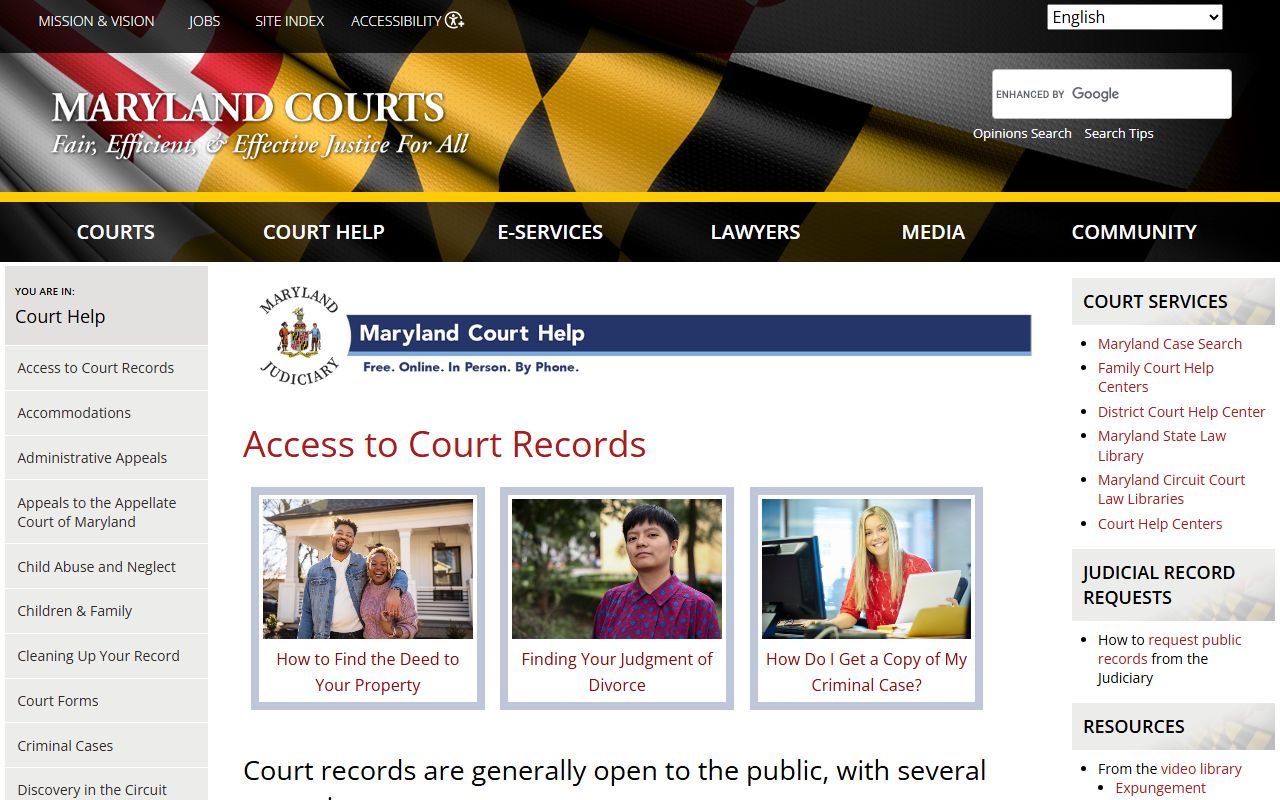
The court records access guide at courts.state.md.us/legalhelp/courtrecords explains the difference between what Case Search shows online and what a full case file contains.
Online Case Search gives you the basics of any DUI case. A full case file goes much further. You get it by visiting the courthouse in person or sending a written mail request to the Circuit Clerk. The full file holds the original charging documents, police reports, and any breathalyzer or blood test results. The arresting officer's probable cause statement is in there. Defense motions and prosecution responses appear as well. If the court ordered probation or a treatment program, that documentation is part of the file too. For most people, the online summary from Case Search is enough to get the core facts. The full file matters when you need certified copies or specific documents from the case.
Arrest records from law enforcement agencies add a separate layer of information. They hold the booking photo, arrest date and time, arrest location, booking number, and the charges at the moment of arrest. Bail and bond amounts appear there too. Police incident reports include the officer's narrative, witness information, evidence collected, and a description of road and weather conditions at the time of the stop.
MVA Driving Records in Maryland
The Maryland Motor Vehicle Administration maintains driving records that are separate from court records. A DUI conviction adds 12 points to the driving record. A DWI conviction adds 8 points. Points stay on the record for two years from the date of the violation. If points accumulate past certain thresholds, the MVA can suspend or revoke the license. A DUI arrest also starts the administrative per se process right away. The arresting officer confiscates the Maryland driver's license and issues a 45-day temporary paper license. A document called the Order of Suspension, form DR-015A, is also issued. License suspension begins on day 46. Drivers who want to fight the suspension must request an MVA hearing within 10 days of the arrest. The request must go out by certified mail, return receipt requested, with a $150 check payable to the Maryland State Treasurer. Send it to the MVA Office of Administrative Hearings, 6601 Ritchie Highway NE, Mail Stop: M-2A-14, Hunt Valley, MD 21062.
Two types of driving records are available from the MVA. The three-year record costs $9 and covers violations over the past three years only. The complete driving history costs $12 and goes back to the start of the person's license. You can order online, by mail, or in person at any MVA branch. The mail-in form is DR-057. Since 2000, Maryland law has blocked public access to other people's driving records. You can only request your own. Law enforcement, insurance companies, and hospitals can request records for authorized purposes.
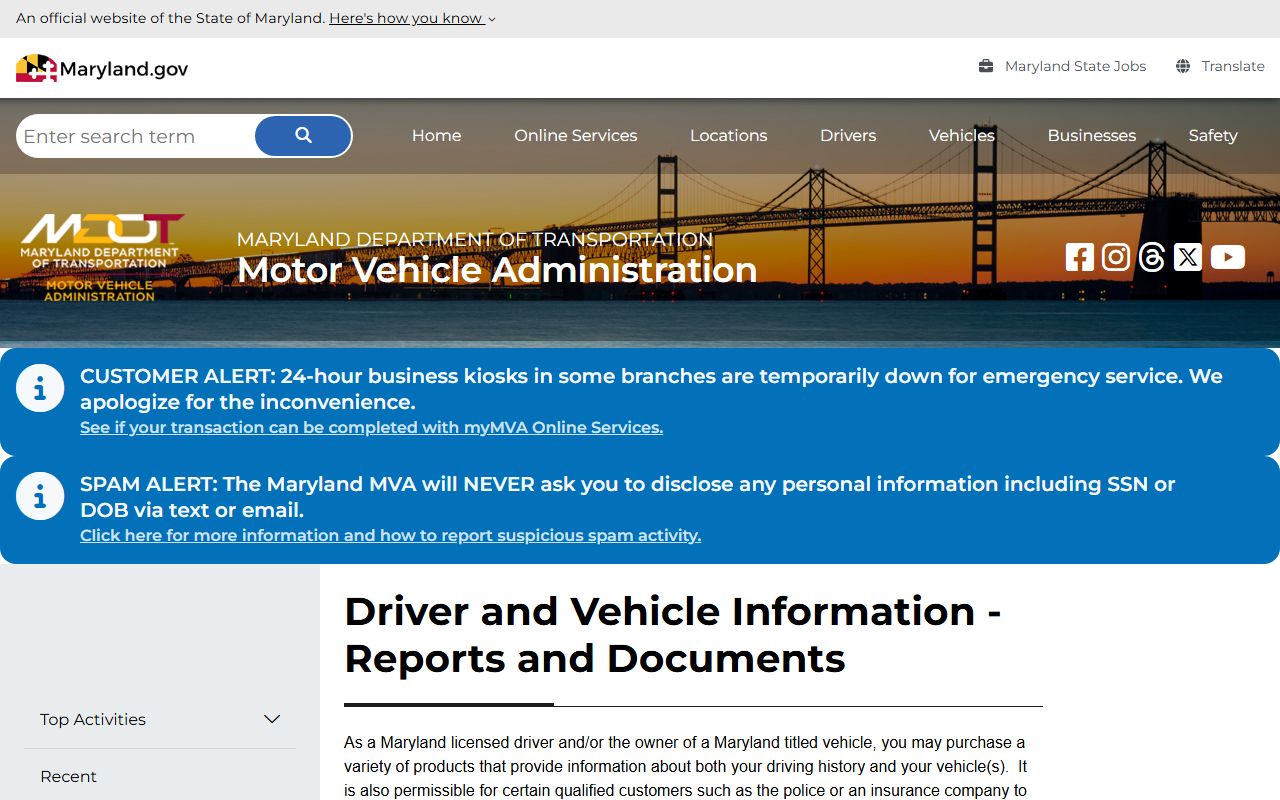
The MVA driver record FAQ at mva.maryland.gov covers all request methods, what each record type includes, and how to get a certified copy for legal use.
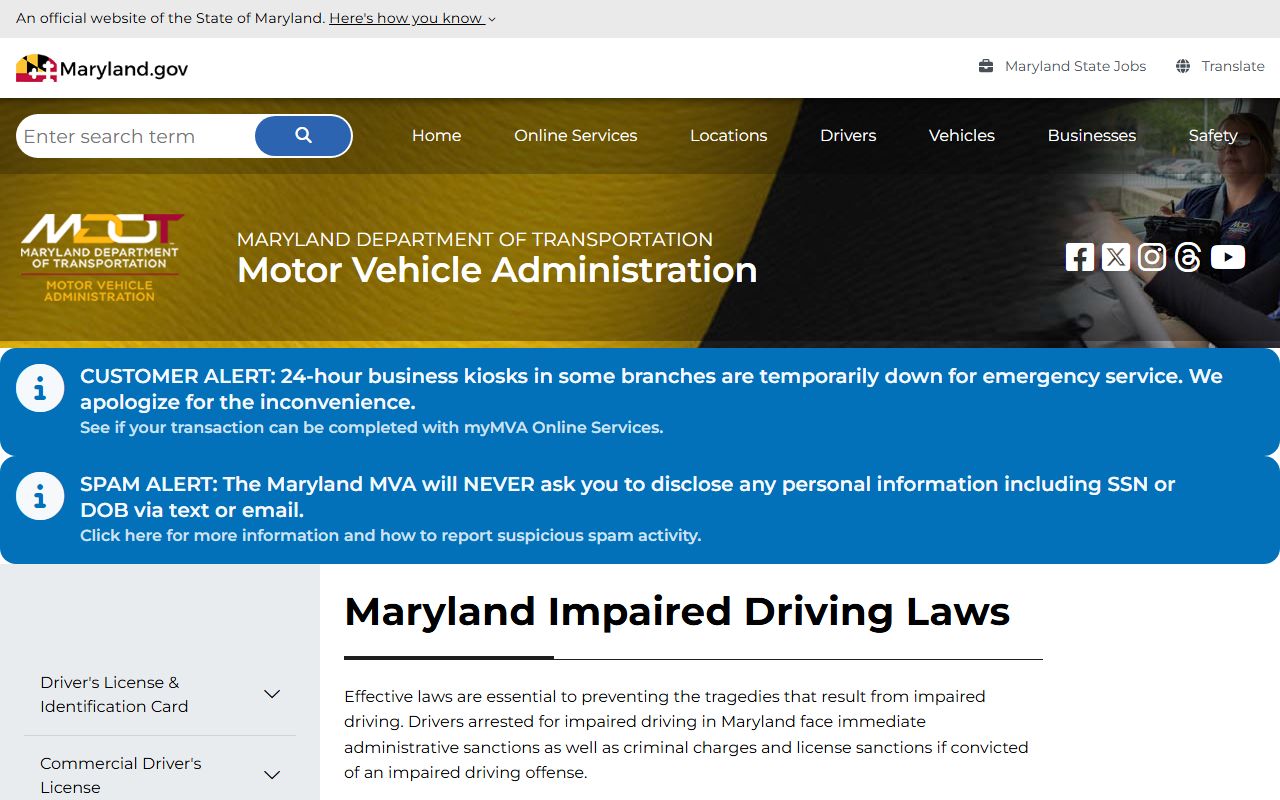
The MVA impaired driving laws page at mva.maryland.gov explains what happens to your license after a DUI stop, covering both administrative sanctions and criminal consequences.
CJIS Criminal History Records
The Criminal Justice Information System Central Repository is run by the Maryland Department of Public Safety and Correctional Services. CJIS is the right source for a formal fingerprint-based background check. Name searches in Case Search can miss records or return false matches. A fingerprint check is more reliable. The CJIS office is at 6776 Reisterstown Road, Baltimore, MD 21215. Hours are Monday through Friday, 8:30 AM to 3:30 PM. Call 410-764-4501 or the toll-free number at 1-888-795-0011. The fee for a full background check is $38. Mail-in requests cost $18 and take 10 to 15 business days. For in-person requests, schedule through the CJIS website, bring valid government-issued photo ID, fill out the CJIS 015 Applicant Fingerprint Card, and submit fingerprints electronically. Results come back by mail within five to seven business days.
The CJIS Central Repository website at dpscs.state.md.us handles appointment scheduling and covers the full fingerprinting process for anyone who needs an official criminal history record in Maryland.
Maryland DUI and DWI Laws
Maryland law sets two levels of alcohol-impaired driving. Both are covered under Md. Code, Transportation § 21-902. DUI, or driving under the influence, applies when a driver's blood alcohol content is .08 or higher. DWI, or driving while impaired, applies at a BAC of .07. DUI is the more serious charge. A first DUI conviction can bring up to $1,000 in fines and up to one year in jail. Twelve points go on the driving record, which can lead to license revocation for up to six months. A mandatory alcohol abuse assessment is also part of the first offense. The Maryland General Assembly site has the full statute text with every subsection spelled out, from alcohol DUI to drug-impaired driving.

The full DUI statute at mgaleg.maryland.gov covers every level of the offense, from basic alcohol DUI under subsection (a) to drug-impaired driving under subsections (c) and (d).
Second and third DUI offenses carry much heavier penalties. A second DUI conviction can mean up to $2,000 in fines and up to two years in prison, with a mandatory minimum of five days behind bars. Two DUI convictions within five years also trigger mandatory ignition interlock. A third DUI offense brings up to $3,000 in fines and up to three years in prison with mandatory interlock for three years. DWI penalties start lower. A first DWI conviction carries up to $500 in fines and up to two months in jail with an 8-point license hit. If a minor child is in the vehicle during any DUI offense, the law adds $1,000 to the fine and up to one year in jail on top of the base penalty. Maryland also has zero tolerance for underage drivers. Any detectable alcohol level is treated as a DUI for drivers under 21. The People's Law Library DUI section has a plain-language breakdown of all these rules and what to expect from the court process.
A breath test refusal carries its own administrative penalties. First refusal brings a 270-day license suspension. A second or later refusal means a two-year suspension. Refusal can also be introduced as evidence in the criminal case.
Noah's Law and the Ignition Interlock Program
Maryland's ignition interlock requirement is known as Noah's Law. It covers all DUI convictions and probation before judgment outcomes for alcohol-related DUI charges. It also applies when a driver picks up two or more DUI charges within five years, or when the MVA revokes a license due to accumulated points from an alcohol-related DUI. The device connects to the vehicle's ignition system. The driver must pass a breath test before the car will start. Rolling retests are required during driving as well. All devices approved in Maryland include a camera. Drivers must choose a provider authorized by the MVA. The program runs for up to three years for repeat offenders.
The interlock program runs through the MVA separately from the criminal case. Courts handle criminal fines and jail time. The MVA manages license status and the interlock requirement. Both processes move on their own timelines.
Note: Maryland's ignition interlock program is managed by the MVA and applies even to drivers who received a probation before judgment rather than a conviction.
Expunging DUI Records in Maryland
Maryland updated its expungement rules for DUI records on October 1, 2024. Under the new law, a DUI probation before judgment can now be expunged after 15 years have passed since discharge from probation. This only applies to alcohol-related charges under Md. Code, Criminal Procedure § 10-105. Specifically, it covers subsections (a) and (b) of Transportation § 21-902. Drug-related DUI charges under subsections (c) and (d) do not qualify. Getting a new conviction during those 15 years blocks expungement. Actual guilty DUI verdicts remain ineligible for expungement entirely. Other outcomes have different timelines. A not-guilty verdict or outright dismissal qualifies right away. Nolle prosequi cases are eligible but not automatic, meaning you must file a petition. Stet dispositions become eligible three years after the entry. A PBJ for a non-DUI offense can be expunged three years after probation ends.
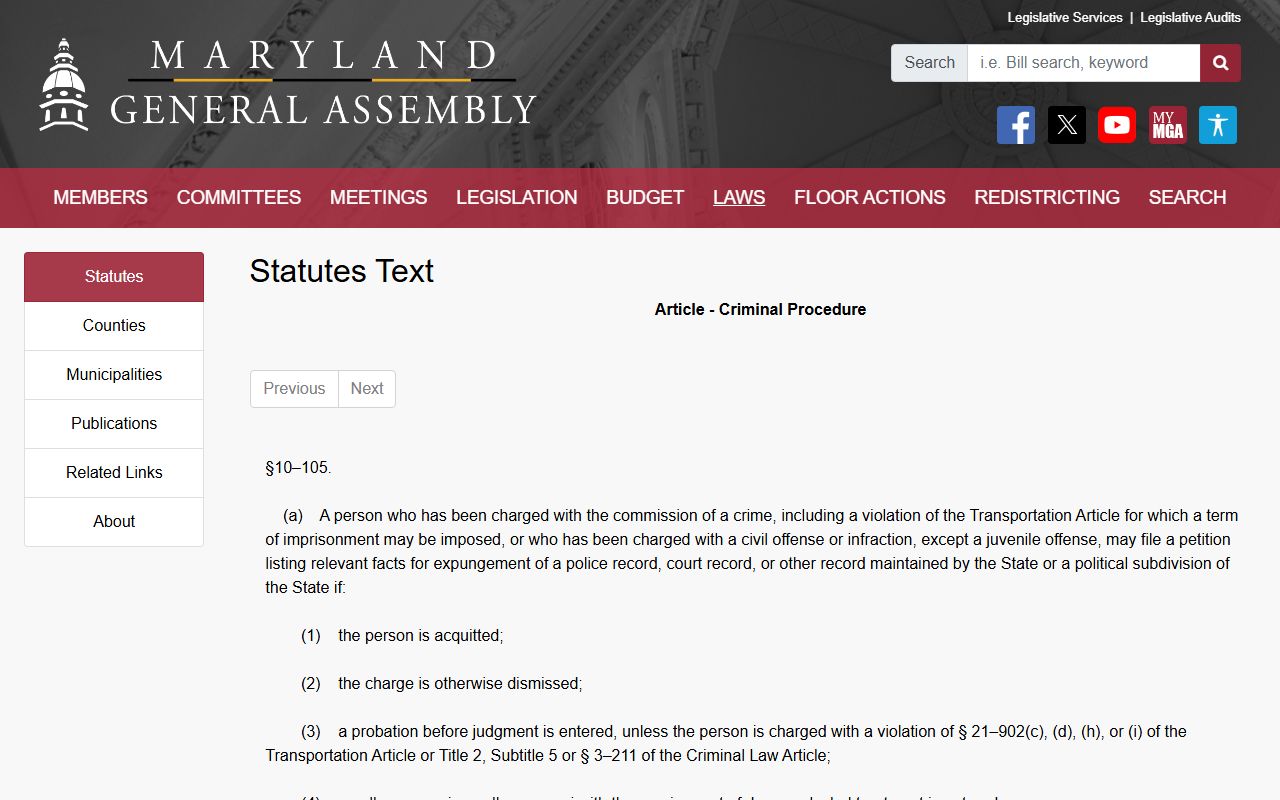
The expungement statute at mgaleg.maryland.gov lays out the full eligibility rules including the 2024 changes that opened PBJ expungement for alcohol DUI after 15 years.
To file for expungement, pick up the petition form from any court clerk's office or the Maryland Judiciary website. Complete it with accurate case information and file it at the courthouse where the case was disposed. The filing fee is $30 per case. Fee waivers are available for financial hardship using Form CC-DC-089. After filing, you must serve a copy on the State's Attorney's Office. If they object, a hearing may follow. The People's Law Library expungement guide walks through eligibility and the petition steps in detail.
The People's Law Library at peoples-law.org/duidwi is a reliable free resource covering Maryland DUI law, the court process, and what happens before and after a case resolves.
Fees for Maryland DUI Records
Maryland Judiciary Case Search is free for online access. Physical copies cost more. Standard photocopies are $0.50 per page at most Maryland courts. A staff-assisted first page costs $5.00 at the Circuit Court. Certified copies of documents add $5.00 per request on top of the photocopy fee. Mail requests typically require a self-addressed stamped envelope and a check made payable to the Clerk of the Circuit Court. For expungement petitions, the filing fee is $30 per case. Court transcripts require a $75 deposit, then $3.00 per page for an original and one copy. Electronic recordings cost $10 per case. Audio recordings from proceedings cost $15 per case. The CJIS background check is a flat $38 in person or $18 by mail. MVA driving records run $9 for a three-year record or $12 for a complete history.
The Maryland Courts portal at marylandcourts.org connects to resources across all 23 counties and Baltimore City, including direct links to courthouse contact pages and record request information.
Note: Confirm current fees directly with the court before mailing a records request, as fee schedules can change over time.
Find Maryland DUI Records by County
Each county in Maryland has its own Circuit Court and District Court that handle DUI cases. Pick a county below to find local court contact details, addresses, and record access information specific to that area.
DUI Records in Major Maryland Cities
Cities in Maryland rely on county courts for DUI case filings. Select a city to learn which county handles those records and how to find the relevant court information.